

Upper Eyelid Lift (Upper-Lid Blepharoplasty)
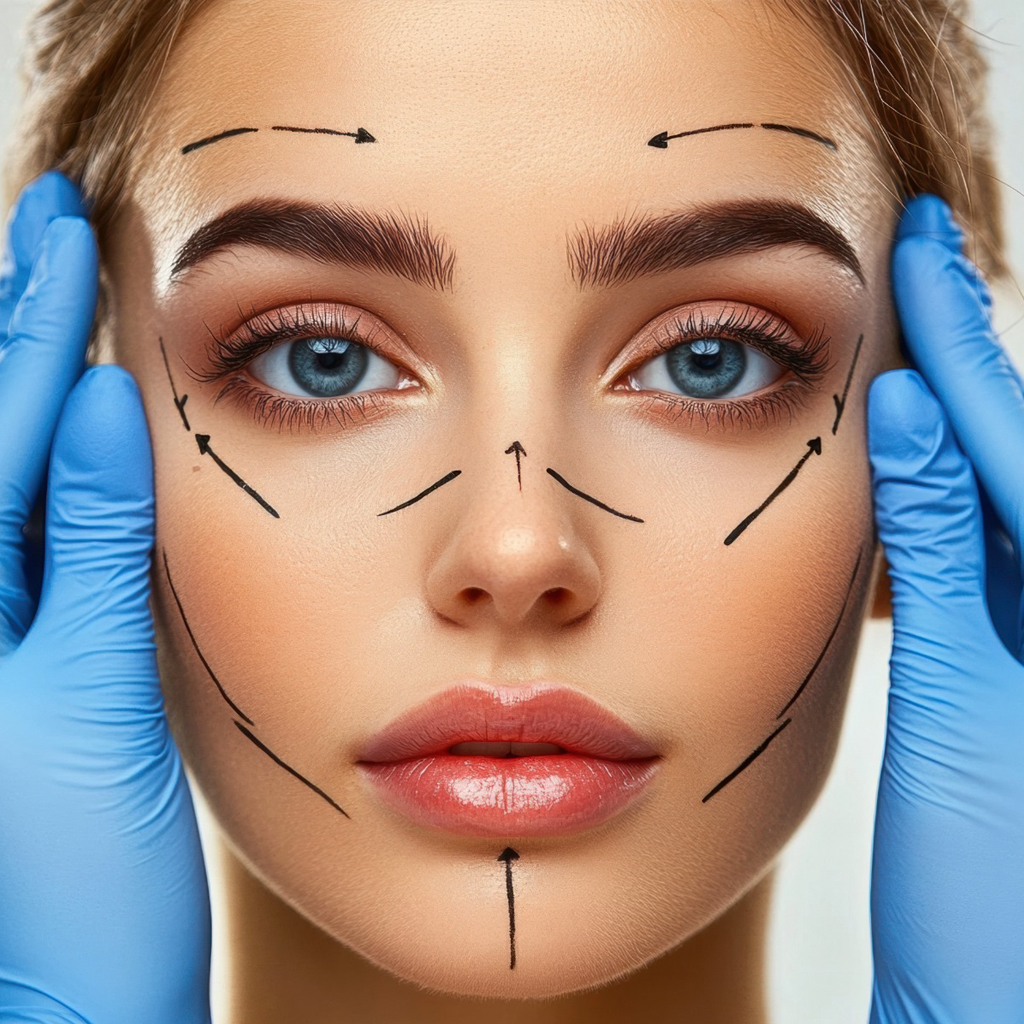
An upper-lid lift corrects a tired, heavy look caused by excess skin, fine wrinkles and, at times, bulging fat of the upper eyelids. The aim is not to “change” your face but to achieve an alert, natural expression that respects your usual facial dynamics. We first analyse the entire upper facial unit: brow height and shape, lid crease, skin elasticity, orbicularis oculi activity, and the distribution of the medial fat compartments. Equally important is distinguishing true skin excess from brow ptosis, which can only mimic heavy lids. This differentiation determines whether an upper-lid lift alone is sufficient or whether a temporal/brow lift should be added.
The procedure uses the natural lid crease as the access. After careful markings in a sitting position, excess skin is removed with millimetre precision; a very thin strip of muscle can be reduced if needed to create a harmonious contour. Medial fat pads are corrected conservatively—often gentle smoothing or partial reduction is enough to define the crease without risking a “hollow” upper lid. Closure is tension-free with fine sutures that later lie virtually invisible in the natural fold.
There are three proven anaesthesia options. Very often, local anaesthesia is sufficient; many patients prefer local anaesthesia with twilight sedation for extra comfort. General anaesthesia is possible for combined operations or special sensitivity. Average operative time—depending on extent and whether one or both sides are treated—is about 45–75 minutes. The procedure is usually outpatient with a short period of observation.
Recovery is predictable. In the first 48 hours, intermittent cooling, head elevation and prescribed eye ointments/drops help with swelling and irritation. Minor bruising migrates downward in the first week and fades. Non-absorbable sutures are typically removed on day 5–7; discreet make-up is possible thereafter. Desk work is often feasible after a few days, social events after about a week; sports should pause 2–3 weeks. We recommend consistent SPF 50+ for the first months to support scar maturation.
Results appear in two phases: immediately the gaze looks more open and the crease more defined; over the following weeks residual swelling smooths out and the scar becomes soft and pale. Longevity is measured in years, but—as with any aesthetic procedure—depends on skin quality, lifestyle and sun protection. Conservative tissue removal is key: less is more when naturalness is the priority. This philosophy helps avoid overcorrections such as an overly deep crease or a hollow supraorbital region.
Risks are overall uncommon but can never be ruled out completely: bruising, temporary dryness or ocular surface irritation, minor asymmetries or a visible early scar. With precise planning, atraumatic technique, meticulous haemostasis and structured aftercare we reduce these risks significantly. If further refinement is desired, adjunct options may help—e.g., gentle laser or peel resurfacing for fine lines, a subtle temporal lift for a low-lying brow, or a light volume support in the upper orbit. The goal is a result that looks fresh and authentic—more “well-rested” than “operated.”