

Forehead & Brow Lift in Istanbul
Overview & objectives
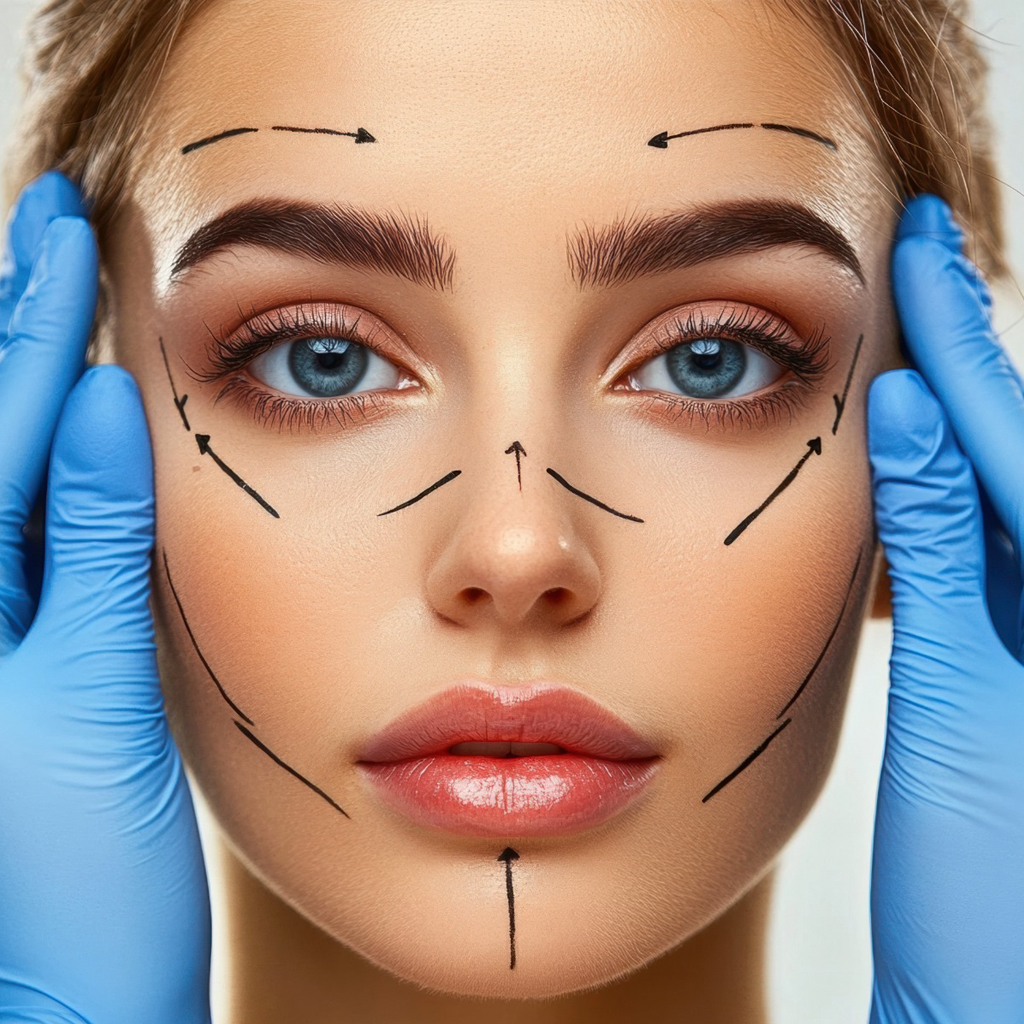
A forehead–brow lift addresses descended brows, horizontal forehead lines, and the heavy, laterally overhanging upper-lid hood. The goal is an alert, positive expression with a clear eye area—without rigid “over-elevation”. We assess brow shape/height, forehead skin elasticity, frontalis activity, and the transitions to the temple and upper lid. Only this full assessment shows whether a frontal brow lift, a temporal accent, a trans-blepharal browpexy, or a direct brow lift at the brow margin will give the best result—possibly combined with an upper-lid blepharoplasty.
Who is a candidate?
Typical candidates present with a persistently tired look from low brows, pronounced forehead lines, reduced brow–crease distance, or a lateral “hood”. After a previous upper-lid lift, the brow position may still be bothersome. Non-surgical options such as botulinum toxin smooth lines temporarily but raise the brow only to a limited extent. When anatomy clearly weighs down the eye area, surgery is the more reliable, longer-lasting solution.
Prominent Ear Surgery / OtoplastySurgery Duration 45-60 minutes Anesthesia Local or general anesthesia Pain Mild Scars Hidden thin scar behind the ear Socially Presentable After 3-5 days Durability Permanent Hospital Stay Daily Healing & Aftercare Bandage and ear protection 1-2 weeks Fully Recovered After 1-2 weeks Visible Results 1-2 months Sports After 2-3 weeks Duration of Stay in Istanbul 1+4 days
Methods & techniques
- Endoscopic forehead lift uses a few short incisions behind the hairline. Through gentle, minimally invasive dissection we release shortened soft tissues, smooth the forehead and elevate the brow along a planned vector. Fixations stabilise the new position; natural expression is preserved.
- Open forehead lift (pretrichial at the hairline or coronal within the hair-bearing scalp) is suitable when excess skin is present or stronger global elevation is needed; the scar is hidden in or at the hairline.
- Trans-blepharal browpexy secures the brow “from inside” via the upper-lid crease—ideal when the brow is only mildly low and an upper-lid lift is planned anyway.
- Direct brow lift sits right at the brow margin; it offers precise shape control but leaves a fine scar and is therefore reserved for selected cases.
The choice depends on hairline, forehead length, brow shape, skin quality and desired expression; we often combine techniques to maximise symmetry and naturalness.
Anaesthesia & procedure
Three proven options are used: local anaesthesia, local anaesthesia with twilight sedation, and general anaesthesia. Endoscopic approaches are typically very comfortable with local + sedation; for open techniques or extensive combinations we often recommend general anaesthesia. After markings in a seated position, we perform tissue-sparing dissection, adjust brow position and secure it under low tension. In Istanbul the procedure is usually outpatient; with extended work an overnight observation can be sensible.
Incisions, natural look & longevity
Incisions depend on method: endoscopic within the hair, pretrichial along the hairline, coronal within the scalp, or discreetly at the brow margin. The aim is always a soft, anatomical brow line—typically a gentle lateral lift of only a few millimetres. Over-elevation looks unnatural, can make the forehead seem rigid, and is deliberately avoided. Results are stable for years; ageing continues, but from a visibly rejuvenated baseline.
Combinations for a harmonious result
Combining with upper-lid blepharoplasty often yields the most balanced outcome, because excess skin and brow position frequently contribute together to a “heavy” eye area. Additional options include CO₂/Er:YAG resurfacing for fine lines, autologous fat micro-grafting for natural volume at temple/zygoma, and a subtle temporal lift. The result is a fresh expression without trend or “done” effect.
Aftercare – practical and detailed
For the first 48 hours we recommend intermittent cooling with soft packs and sleeping with the head slightly elevated. Avoid tension on the forehead/temple; hair washing with lukewarm water and mild shampoo is fine from the next day. Mild swelling and tightness are normal and settle markedly within a week; small bruises descend and fade. Non-absorbable sutures are removed on days 5–7. Make-up on the upper third of the face only after clearance; SPF 50+ for the first months is mandatory to ensure good scar maturation. Avoid sport, sauna and strong facial exertion for 2–3 weeks; gentle walks are encouraged to support circulation and lymph drainage. Check-ups in weeks 1 and 3, and later if needed, ensure fixations remain stable, swelling resolves symmetrically and fine-tuning can be made in time.
Risks & safety
As with any operation, postoperative bleeding, infection, prolonged swelling, numbness in hair-bearing areas or asymmetries can occur—overall uncommon. Risk decreases with precise indications, tissue-sparing technique, meticulous haemostasis and structured aftercare. Honest counselling about scar, hairline and expression is part of our planning—so expectations remain realistic and results durably satisfying.