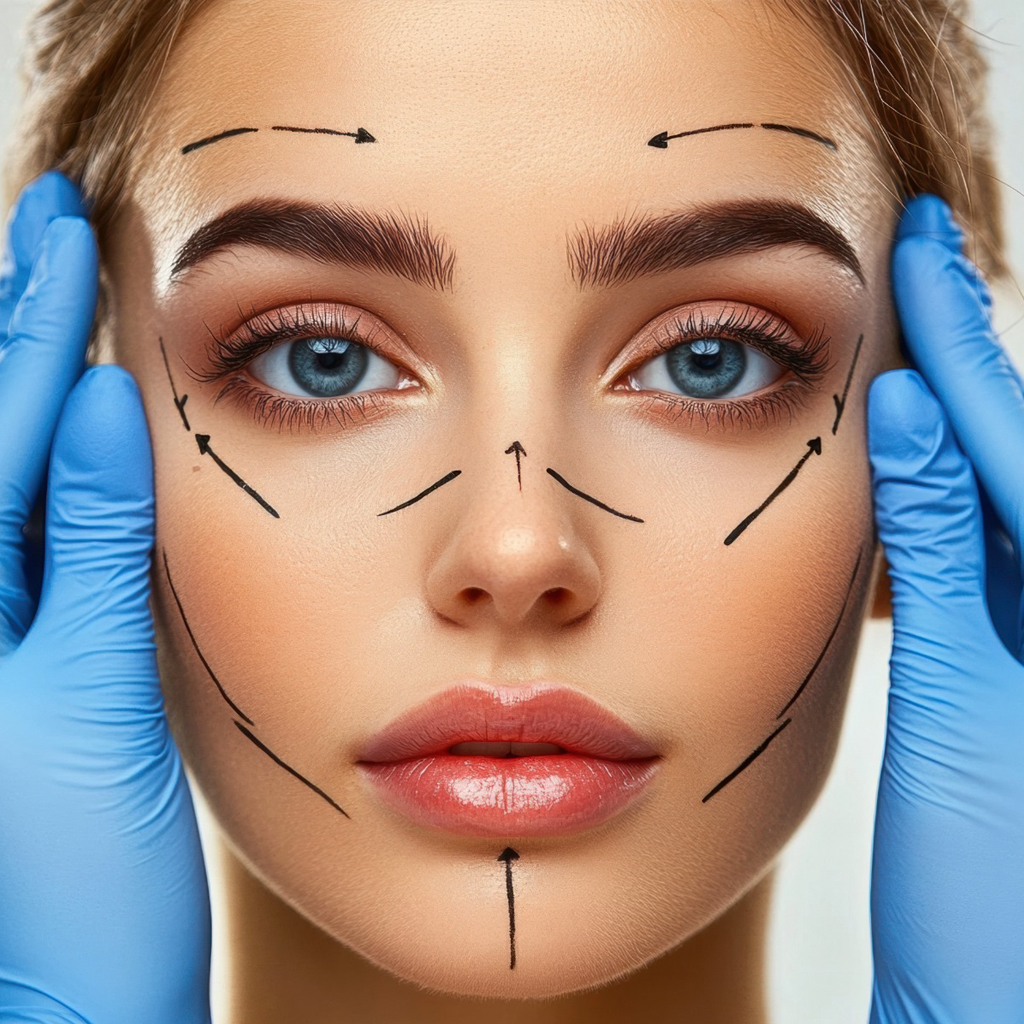



Temporal Lift (“Fox Eyes”) in Istanbul
Overview & objectives
A temporal lift—also called a temple lift or lateral brow lift—elevates the outer brow and tightens the lateral forehead. The gaze looks more alert, the lateral upper-lid hood feels lighter, and the contour towards the cheekbone is more defined. While “fox eyes” describes a slightly up-swept eye shape, we prioritise natural harmony over trends. We plan lift and vectors so that expression, brow shape, hairline and upper-lid crease work together.
Who is it suitable for?
A temporal lift is helpful for a laterally descended brow, a tired outer eye area with an otherwise stable central forehead, or for patients seeking a subtle lateral upswing. Often there is a lateral “hood” while the centre has dropped only slightly. It’s not ideal as a sole procedure for globally low brows or deep central forehead lines—in such cases a forehead/brow lift offers better control. Consultation distinguishes true brow ptosis from pure upper-lid skin excess.
Methods & techniques
Two main surgical routes are used and tailored to your anatomy.
- Endoscopic temporal lift: very short incisions in the hair-bearing temple, minimally invasive mobilisation of lateral forehead tissues, precise vector setting and internal fixation with resorbable systems. Benefits: tiny scars, controllable lift, quick recovery.
- Open mini-temporal lift: curved incision in or just at the hairline when extra skin needs tightening or a stronger lateral effect is desired. Scar hides within hair; allows fine surface tightening.
Suture/“thread” techniques can create a short-term accent but are less predictable. With lax lateral canthus we add a canthopexy to stabilise the outer lid corner. Volume deficits at zygoma/temple can be refined with autologous fat micro-grafting—lift plus volume often looks most natural.
Anaesthesia & procedure
Options: local anaesthesia, local + twilight sedation, or general anaesthesia. Endoscopic variants are very comfortable with local + sedation; open techniques or combined procedures may benefit from general anaesthesia. After seated markings we perform tissue-sparing dissection along planned vectors, fix the new position and close under low tension. Usually outpatient; cooling and a short observation complete the day.
Combinations & alternatives
For a coherent upper face we often combine a temporal lift with an upper-lid blepharoplasty when excess skin also hides the crease. Lower-lid fat repositioning smooths bags; CO₂/Er:YAG resurfacing treats fine lines; fat shaping harmonises the cheekbone line. If the main issue is central, a forehead/brow lift is the better primary choice; the temporal lift then serves as a lateral fine-tune.
Aftercare — clearly explained
For the first 48 hours use intermittent (not icy) cooling and sleep with the head elevated. Avoid tension on the temples; hair washing from the next day with lukewarm water and mild shampoo. Mild swelling, tightness and bruising are normal and reduce markedly within a week. Non-absorbable sutures are removed on days 5–7. Make-up at the temples only after clearance; SPF 50+ for several weeks is mandatory. Pause sport, sauna and heavy chewing for 2–3 weeks; gentle walks aid lymphatic drainage. Follow-ups ensure symmetry, nerve sensation and scar maturation; if needed we support with lymph/scar care or a mild laser refresh.
Risks & safety
Complications are uncommon but possible: bleeding, infection, prolonged swelling, altered sensation in hair-bearing scalp, mild asymmetries or—rarely—outer canthus irritation. We minimise risk with gentle dissection, secure fixation, sterile technique and structured aftercare. Natural results depend on moderate elevation: a few millimetres are enough to open the gaze without altering expression or forehead tone.