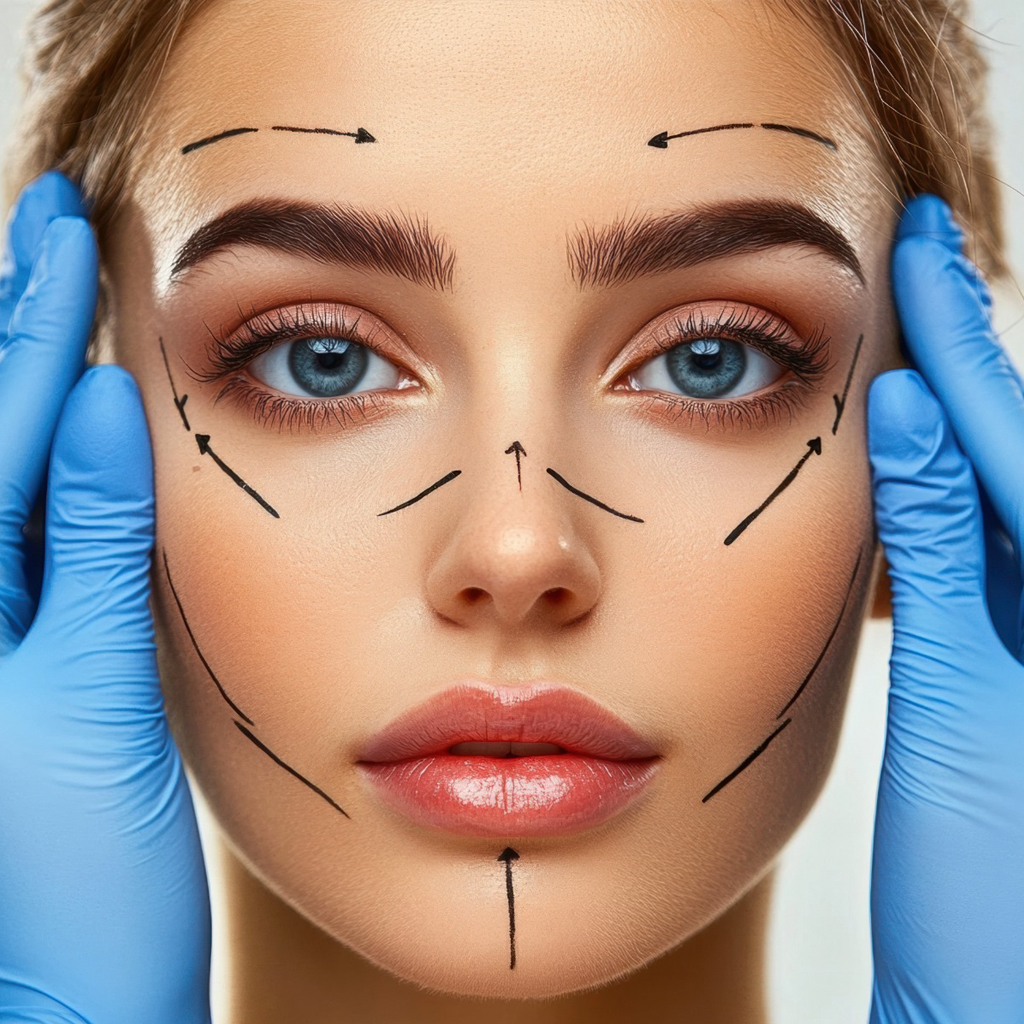


Facelifting in Istanbul – look naturally younger without a “mask”
SMAS/deep-plane techniques, safe aftercare, honest expectation management — without 3D simulations.
What a facelift can – and cannot – achieve
A “facelift” is not skin pulling; it is three-dimensional re-shaping of descended soft tissue. Ageing signs stem from volume loss, lax retaining ligaments, SMAS laxity (the subcutaneous musculo-aponeurotic system) and skin quality. A modern facelift targets:
- Jawline & cheek–jaw border (jowls, marionette lines)
- Midface (flattened cheek, tear-trough transitions)
- Neck (horizontal bands, platysma cords, submental fat)
Not everything is solved surgically: skin texture, pores, sun damage, pigment and fine crêpe lines need adjunct skin medicine (peel, laser, microneedling, biostimulators, exosome concepts). Nasolabial folds usually improve but rarely disappear — they belong to facial expression.
Face Lift / RhytidectomySurgery Duration 2-4 hours Anesthesia General anesthesia Pain mild pain and pulling sensation Scars Hidden scar around the ear and scalp Socially Presentable 1-2 weeks later Durability 10-15 years Hospital Stay 1-2 nights Healing & Aftercare Bandage and drain follow-up 1 week Fully Recovered After 1 week Visible Results 3-6 months Sports 4-6 weeks later Duration of Stay in Istanbul 1+4 days
When a facelift is sensible
There is no “mandatory age”. Findings and expectations count, not your birth date.
- Early signs (late 30s–mid 40s): early jawline blurring, mild cheek descent → Mini/MACS lift or high-SMAS-“light”; often with structural fat.
- Moderate signs (mid 40s–mid 50s): jowls, neck definition lost → SMAS/high-SMAS; platysmaplasty if the neck is involved.
- Pronounced signs (50+): marked descent, platysma bands → deep-plane/high-SMAS plus neck; planned volume restoration.
Chronology vs biology: smoking, UV, major weight shifts, genetics and hormones accelerate facial ageing. Treating earlier often yields more natural, longer-lasting results because smaller vectors need correction — not an “overhaul”.
Techniques — explained clearly
SMAS lift (plication/imbrication)
Tightens or folds the SMAS “carrier carpet”, taking tension off the skin. Pros: natural vectors, stable jawline, shorter recovery. Limits: strongly tethered ligaments (zygomatic/mandibular) can restrict mobilisation.
High-/extended-SMAS
Work extends over the zygomatic arch; key retaining ligaments are released. Result: better midface elevation, a cleaner zygomatic light line. Slightly more dissection, stronger effect without skin tension.
Deep-plane facelift
Skin + SMAS are mobilised as one layer; deeper tetherings are released. You “reposition the sofa with the carpet”, not just pull the cover. Pros: very natural cheek fullness, strong nasolabial softening, durable. Requires experience, OR time and meticulous haemostasis — the gold standard for pronounced cases in trained hands.
MACS/mini-lift
Shorter preauricular incisions, vertical vectors with suture anchors. Good for early signs; limited neck effect. Often combined with submental lipo and a small platysma stitch.
Neck lift (cervicoplasty/platysmaplasty)
The neck ages on its own. Options: submental lipo, anterior/posterior platysmaplasty (re-approximation/side fixation), possibly skin excision behind the ear. A sharp cervicomental angle depends on this neck component.
Adjuncts
- Structural autologous fat (micro/nano): fills A-zones (zygoma, pre-zygomatic groove), smooths transitions, improves skin.
- Brow/temporal lift: not part of a facelift, but often combined if the brow/forehead is low.
- Eyelids (upper/lower): for skin excess or bags.
- Buccal fat: cautious, selective — not routine.
Rule of thumb: we don’t pull skin; we reset the deep layers.
Scar placement, hairline & ethnicity
Incisions follow natural borders: in front of the ear (tragus), around the lobule and behind the ear into the hairline.
Women: temporal hair can be integrated elegantly.
Men: we respect beard margins and sideburns — displacement looks unnatural.
Different skin types react differently: thicker, seborrhoeic, pigment-rich skin needs gentler tension and diligent scar/UV care; keloid-prone types require prophylaxis (silicone, possibly steroid taping).
Anaesthesia & setting in Istanbul
Facelifts are performed under general anaesthesia or twilight sedation + local — depending on technique, neck component and profile. Istanbul offers compact specialty clinics (short pathways, seasoned teams) and full hospitals with ICU backup. We choose setting & team by risk profile, not by package. We deliberately do not use 3D simulations; they are manipulative. We work with photo-metrics, sketches, comparable cases and clear words on chances and limits.
Men vs women — different aims
- Men: sharper jawline, straighter cheek vectors, intact beard line; over-correction looks “operated”.
- Women: slightly more vertical vectors, more cheek fullness allowed, soft transitions to temple/orbit.
- Everyone: the neck–chin line creates the “wow”. Without the neck there is no “young” face.
What a facelift does not replace
- Skin texture/pores → dermatologic care (laser/peel/needling/biostimulators)
- Severe volume loss without filler/fat → unrealistic
- General obesity-related fat pads → weight management first
- Psychological expectations → realistic goals, not a “new person”
Durability & real life
Good, layer-correct techniques last many years. As a guideline: SMAS/high-SMAS 8–10 years, deep-plane 10–15+ years — modified by genetics, weight, nicotine, UV, skincare. A later mini “refit” (e.g., temporal/buccal) is normal; that’s maintenance, not failure.
Risks — openly stated
- Haematoma/bleeding (early revision may be required), seroma
- Nerve irritation (temporary weakness of frontal or marginal mandibular branch), rarely persistent
- Skin-edge perfusion/necrosis — nicotine is the biggest risk
- Temporal alopecia from wrong tension, hypertrophic/keloid scarring (disposition)
- Infection, salivary fistula (parotid), thrombosis/embolism (rare but serious)
Safety comes from atraumatic dissection, meticulous haemostasis, brief drains, pressure management, thrombosis prophylaxis and an honest operative scope.
Preparation — what matters before surgery
- Nicotine stop: at least 4 weeks before, 4–6 weeks after.
- Medications & supplements: anticoagulants, NSAIDs, vitamin E, ginkgo, retinoids — pause/switch per medical advice.
- Skin prep: UV protection, gentle retinoid/AHA schemes, rosacea control if needed.
- Planning without illusions: photos, measurements, real comparable cases instead of 3D.
- Logistics: compression, cold packs, high-protein intake, sleep on your back with head elevated.
Course & aftercare — realistic timeline
OP day to day 2
Rest, head elevated, cooling (no moisture). Speak/chew/turn gently. Remove drains early if placed. Pain/antiemetic protocol, early mobilisation.
Days 3–5
Swelling peaks; bruises descend. First dressing change; assisted hair wash if needed. No nicotine/heat.
Week 1
Some sutures out (area-dependent). Office/Zoom often possible; avoid long travel. Gentle walking encouraged.
Weeks 2–3
Back to daily life without strain peaks; make-up ok. Scar care with silicone gel/tape; strict sun protection.
Weeks 4–6
Light sport; no impact. Lymphatic drainage/LED if useful. Night neck support if major neck work.
Months 3–6
Form matures; sensory changes fade. Skin-medicine add-ons (peel/laser) can be staged.
Facelift combinations — yes, but planned
- Eyelid surgery (upper/lower) often fits in one session.
- Brow/temporal lift when the forehead has descended — or staged to distribute swelling.
- Fat grafting is often helpful (A-zones).
- Laser/peel preferably later, to protect wound healing.
Combinations are possible when OR time, blood loss and positioning remain safe. If in doubt, we stage — safety before marketing.
Men’s specifics: beard, hairline, activities
Beard growth must not “move” into the ear. We plan the tragus incision to keep shaving natural. Occupations/hobbies with helmets or contact sports may need longer protection. Sun protection is mandatory — or hyperpigmentation threatens.
Common misconceptions
- “Pulling makes you young” — wrong. Deep repositioning (SMAS/deep-plane) does; skin then lies relaxed.
- “I want no scars” — scars always exist, but placed so you don’t look for them.
- “Threads are enough” — temporary, risk lymphatics, do not replace a facelift.
- “I’m 65 — too late” — no. Vessels, skin and general health matter more than age.
Cost drivers — why prices vary
Technique (MACS vs high-SMAS vs deep-plane), neck component, OR time, anaesthesia, inpatient need, team size, add-ons (fat, eyelids, brow), aftercare — all determine effort. We take no clinic kickbacks; we purchase quality and assemble the team to fit your case.
In short
We don’t “pull”, we reset — in the deep layers. With vectors that suit your face, the neck as the key, and aftercare planned before surgery. The result: fresh, not “done” — and proven over years.